


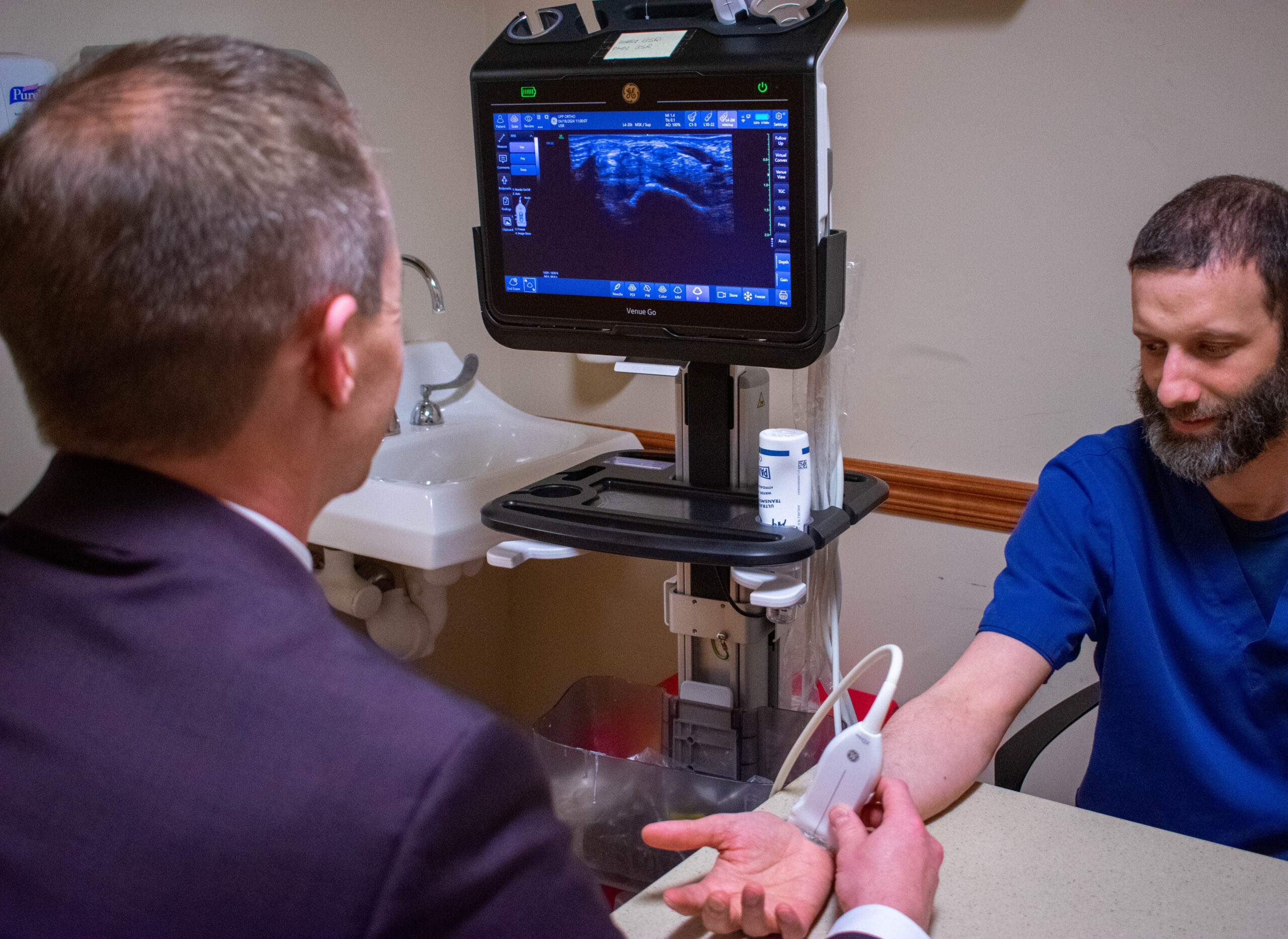
John Fowler, MD, is a professor in the Department of Orthopaedic Surgery at the University of Pittsburgh School of Medicine. He also works closely with orthopaedic surgery trainees as associate director of the residency program and the hand surgery fellowship. His clinical research focuses on the use of musculoskeletal ultrasound to improve the accuracy and efficiency of diagnosis for carpal tunnel syndrome and to improve patient satisfaction. He shares his research expertise as assistant dean for medical student research.
Can you share a bit about your early life and what sparked your interest in research, medicine, and orthopaedics?
I was born in Pittsburgh and grew up in Plum until about third grade, when my family moved to Erie. I have always been interested in science and started to think about being a doctor in eighth grade. I like the idea of combining my interest in science with directly helping people. Once I got to medical school, I quickly knew that a surgical field was best for me because in surgery we are able to actually “fix” problems rather than relying on patient compliance and medications. Orthopaedics was my favorite because we took care of a wide range of people and focused more on improving quality of life rather than saving lives.
What were some pivotal moments or influences during your education that shaped your research interests?
My pivotal moment with respect to ultrasound came in the resident-run orthopaedic clinic at Temple University Hospital. We would see people with carpal tunnel syndrome and send them for confirmatory nerve testing. It would take months for people to schedule that testing, and so many got lost in the shuffle and never got the testing. I started looking for an alternative way to confirm a diagnosis of carpal tunnel syndrome and came across ultrasound. I started doing research on it and have never looked back.
What were your initial career goals when you started your journey in research, and how have they evolved over time?
My career goal has always been to improve the lives of my patients while being a kind and normal guy. So many times, medicine is impersonal and there is a lot of bad behavior from physicians with respect to bedside manner. From a research standpoint, I try to stay very practical with research that impacts patients on the front lines in the clinic or operating room.
Are there specific achievements or milestones you aspire to reach in your career?
I have actually never written down a goal or thought much about this. I have always been a big believer that if you show up every day, work hard, and treat people with kindness and respect, the rest will take care of itself.
Could you provide an overview of your current role at BMRC and responsibilities in your research position?
I am the director of SUPER (Surgery of the Upper Extremity Research) and direct hand and upper-extremity research studies for our group.
Research can be demanding. How do you maintain a balance between your professional and personal life?
I have tried to be ultra-efficient in everything that I do. I squeeze extra time out of the day by being efficient in the mundane tasks or even in clinical care. The key to efficiency is that you are doing it fast and correctly, which is important. Doing medicine fast and sloppy is a setup for disaster.
Are there any recent developments or breakthroughs in your field that particularly fascinate you?
Ultrasound technology has continued to become more portable, less expensive, and of higher quality. This is incredibly exciting for our field and is going to lead to more and more breakthroughs in this arena.
Are there specific areas within your field that you are particularly interested in exploring further in the coming years?
The use of machine learning and artificial intelligence is the next frontier. The machine will automatically measure the cross-sectional area of the nerve, color-code tendons/nerves/bone/blood vessels. It will identify fracture and nerve conditions without human input. Exciting times!